
Keratoconus

The cornea becomes thinner and bulges into a cone. Vision turns blurred and distorted, even with glasses.
In short

  • In keratoconus the cornea, the clear window at the front of the eye, becomes thinner and more curved.
  • The cone shape bends light unevenly, so you see blurred or doubled images and streaks around lights.
  • It usually starts between the ages of 15 and 30 and often settles down after that.
  • Your prescription keeps changing, especially the cylinder, and glasses stop giving sharp vision.
  • Rubbing your eyes hard makes it worse. Not rubbing is the most important thing you can do.
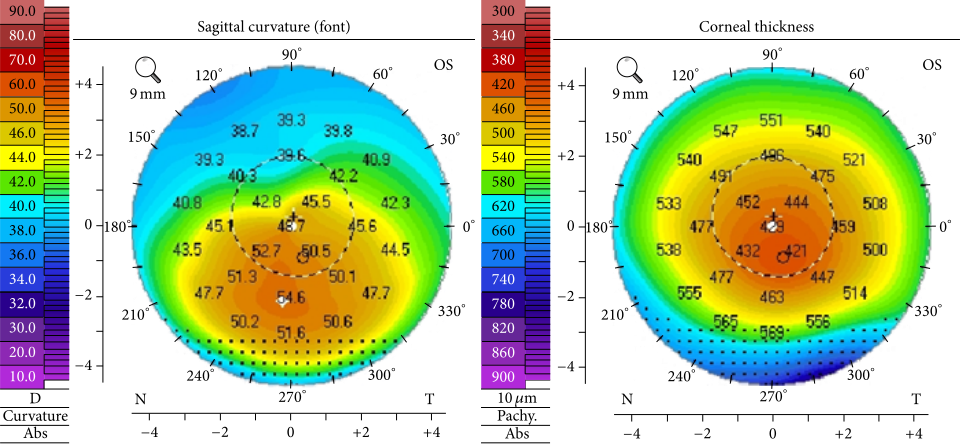
Corneal scan in keratoconus: curvature on the left, corneal thickness on the right
Corneal scan in keratoconus: curvature on the left, corneal thickness on the right Elise A. Slim et al., CC BY 4.0. Via Wikimedia Commons.

Symptoms

  • Blurred, distorted vision; straight lines look bent.
  • Several overlapping images with one eye, even with the other eye closed.
  • Streaks, halos or starbursts around lights, especially at night.
  • Frequent changes in your glasses or lens prescription, with increasing cylinder.
  • Sensitivity to light and often itchy eyes.

How it develops

The tissue of the cornea is weaker than normal, so the pressure inside the eye slowly pushes it forward into a cone. Rubbing the eyes speeds this up. Keratoconus runs in families and is more common with allergy, hay fever and eczema. It mainly progresses between the ages of 15 and 30 and usually stops around the age of 40.

Treatment

  • The diagnosis needs a corneal scan (topography), made by the ophthalmologist after referral.
  • Early on, glasses or a soft contact lens may still give sharp vision.
  • When the cornea becomes more irregular, rigid or scleral lenses are needed.
  • Cross-linking by the ophthalmologist stops further progression but does not improve vision.
  • A corneal transplant is needed in a small number of people.
  • Laser eye surgery is not possible in keratoconus; it makes the cornea thinner.

When to get help the same day

Contact your GP or the out-of-hours GP service (huisartsenpost) straight away if you have:

  • Sudden severe loss of vision with pain, a red eye and a white spot on the cornea
  • A painful, red or light-sensitive eye while wearing contact lenses
  • Vision that gets clearly worse within a few days

This page is a short summary and does not replace a consultation. Want to know how the eye works? See The eye.