
Dry eyes
Dry eyes feel burning or gritty, and sometimes they water. Most people start with artificial tears, but that only eases the feeling; it does not remove the cause.
That is why our optometrists carry out a thorough dry eye examination. We measure the amount of tear fluid, the stability of the tear film and the condition of your eyelid margins and cornea. Then we know which type of dry eye you have and which treatment fits: from targeted drop and eyelid advice to punctal plugs.
The examination is fully covered and does not affect your deductible.
Dry eyes
Dry eyes feel burning or gritty, and sometimes they water. Most people start with artificial tears, but that only eases the feeling; it does not remove the cause.
That is why our optometrists carry out a thorough dry eye examination. We measure the amount of tear fluid, the stability of the tear film and the condition of your eyelid margins and cornea. Then we know which type of dry eye you have and which treatment fits: from targeted drop and eyelid advice to punctal plugs.
The examination is fully covered and does not affect your deductible.
What are dry eyes?
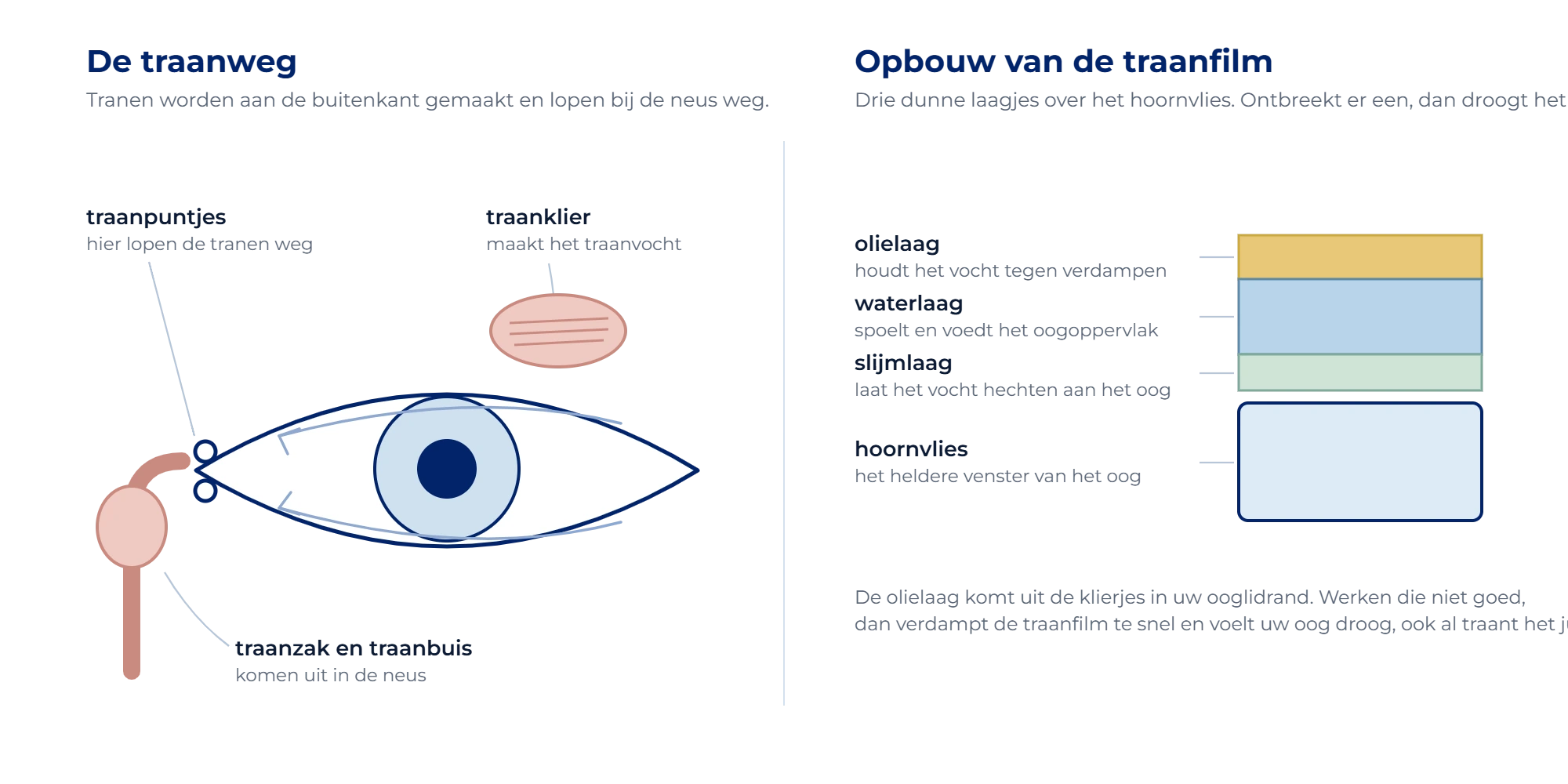
A thin layer of tear fluid covers your cornea: the tear film. It keeps the surface smooth and clear, removes dirt and protects against infection. It has three layers that need each other: oil, water and mucus.
If one layer fails, the film becomes unstable and breaks up too quickly, exposing the surface. That irritates the many nerve endings in the cornea, which is why dry eyes can be so unpleasant while little is visible from outside.
The medical name is keratoconjunctivitis sicca or dry eye syndrome. It is usually chronic: often not curable, but well manageable once the cause is clear.
Two types of dry eye
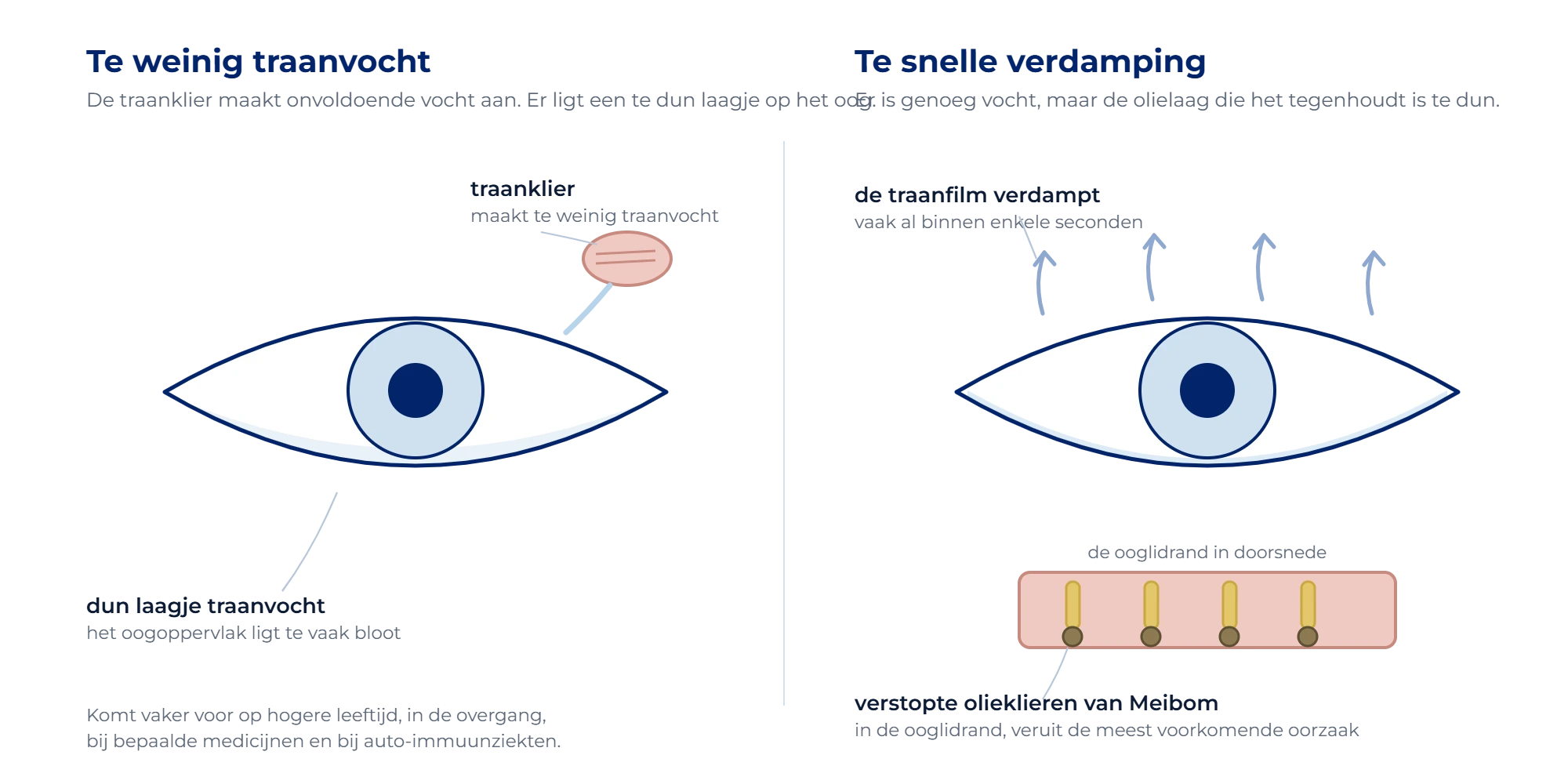
Too little tear fluid. The tear gland produces too little. More common with age, during and after menopause, with certain medicines and with autoimmune diseases such as Sjögren’s syndrome.
Evaporation too fast. The tear gland works fine, but the oil layer is too thin because the meibomian glands in the lid margins are blocked or inflamed. This is by far the most common type.
In practice both often occur together, so we always look at both.
Symptoms: how do you recognise dry eyes?
- A burning or stinging feeling, especially at the end of the day.
- A gritty feeling, as if there is a grain in your eye.
- Watery eyes. This sounds contradictory but makes sense: the dry surface is irritated and the eye reacts with watery reflex tears that do not stay on the eye.
- Blurred vision that clears when you blink. An unstable tear film briefly blurs the image.
- Red, tired or heavy eyelids, with sticky or gritty eyes on waking.
- Poor contact lens tolerance, or lenses that start to scratch later in the day.
- Sensitivity to wind, air conditioning, smoke and bright light.
Symptoms that worsen with screen work, driving or wind point to dryness. Symptoms worst in the morning point more to the eyelid margins.
Do not wait if you have: sudden reduced vision, severe pain, a lot of discharge or a red eye after an injury. These need assessment the same day: contact your GP or the out-of-hours GP service (huisartsenpost).
Causes of dry eyes
Screen work
Behind a screen you blink up to half as often, and often incompletely, so the oil layer is not spread well. A high screen also exposes more of the eye.
Contact lenses
A lens splits the tear film and speeds up evaporation, and can irritate the lid margins. A different material, replacement schedule or solution often helps.
Blepharitis and blocked oil glands
Blepharitis and meibomian gland dysfunction are the main causes of evaporative dry eye. Flakes along the lashes, red lid margins and recurring styes are signs.
Hormonal changes
Symptoms often increase around and after menopause. Pregnancy, the pill and thyroid disorders also play a role.
Medicines
Antihistamines, diuretics, beta blockers, antidepressants, antacids and isotretinoin can reduce tear production. Bring your current medication list to the appointment.
Age and general conditions
Tear production decreases with age. Rheumatism, Sjögren’s syndrome, diabetes and rosacea are more often combined with dry eyes.
After laser eye surgery or eyelid surgery
Dry eyes are common after a refractive procedure and usually improve over the following months. We do both the pre-assessment for laser eye surgery and lens replacement and the follow-up, and always check the tear film.
Environment
Air conditioning, underfloor heating, wind, dry cabin air and smoke dry out the eye surface further.
GP, optometrist or ophthalmologist?
With persistent or recurring symptoms, start with your GP. Your GP checks for general causes and can refer you, easily via ZorgDomein.
An optometrist is the right care provider once artificial tears are not enough and the question is why your eyes are dry. We have the equipment and time to examine the tear film and lid margins systematically, and we can treat.
An ophthalmologist comes in with corneal damage, suspected autoimmune disease or insufficient results. We then refer in a targeted way and send our findings.
Our dry eye examination: how we find the cause
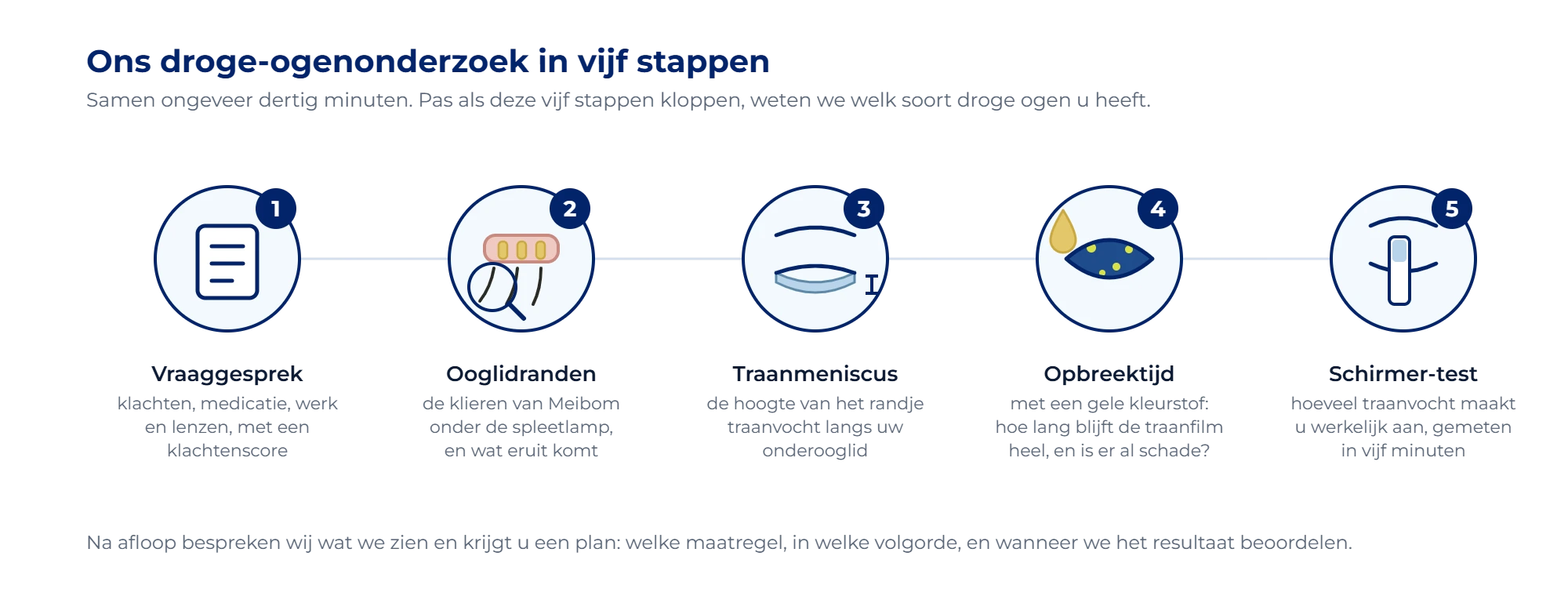
This is what sets us apart from a standard eye test. Allow about thirty minutes. We take that time because the cause rarely shows from one measurement.
1. Interview and questionnaire
When are symptoms worst, what makes them worse, which drops do you use? We review medication, work, lenses and general health, and score your symptoms with a standard questionnaire so we can measure progress later.
2. Slit lamp examination of the lid margins
Under high magnification we assess the lash line, the gland openings and the quality of the oil. We gently express the glands: clear oil, cloudy paste or nothing?
3. Tear meniscus height
The strip of tear fluid along your lower lid tells us directly about your tear supply.
4. Tear break-up time with fluorescein
A harmless yellow dye shows how long the tear film stays intact. Under ten seconds means it is too unstable. The same dye shows any damage to the cornea.
5. Schirmer test
A small paper strip in the lower lid measures how much tear fluid you produce in five minutes. This distinguishes too little tear fluid from evaporation, which determines the treatment.
What you get afterwards
We discuss our findings and give you a concrete plan: which measures, in which order and when we evaluate. If needed, your GP receives a report.
What should you bring? Your ID, glasses, current medication list and the drops you use now. If you wear lenses, come without them or take them out at least two hours before.
Please note: you may be given eye drops. We usually do not dilate the pupils for this examination, but sometimes it is needed. Your vision is then blurred for a few hours and you may not drive yourself. Bring sunglasses.
Treatment of dry eyes
No single remedy works for everyone. We build the treatment in steps, starting with the least invasive measure that fits your type.
Tailored drop advice
Artificial tears come in dozens of types: watery, with hyaluronic acid, with lipids, as gel or night ointment. Which suits you depends on your type. Two rules: drop at fixed times rather than only when it stings, and switch to drops without preservatives once you use drops more than four times a day. Preservatives irritate the surface you want to protect.
Eyelid hygiene and warm compresses
For blocked oil glands this is the basis, and it only works if done consistently. We explain and show the technique step by step.
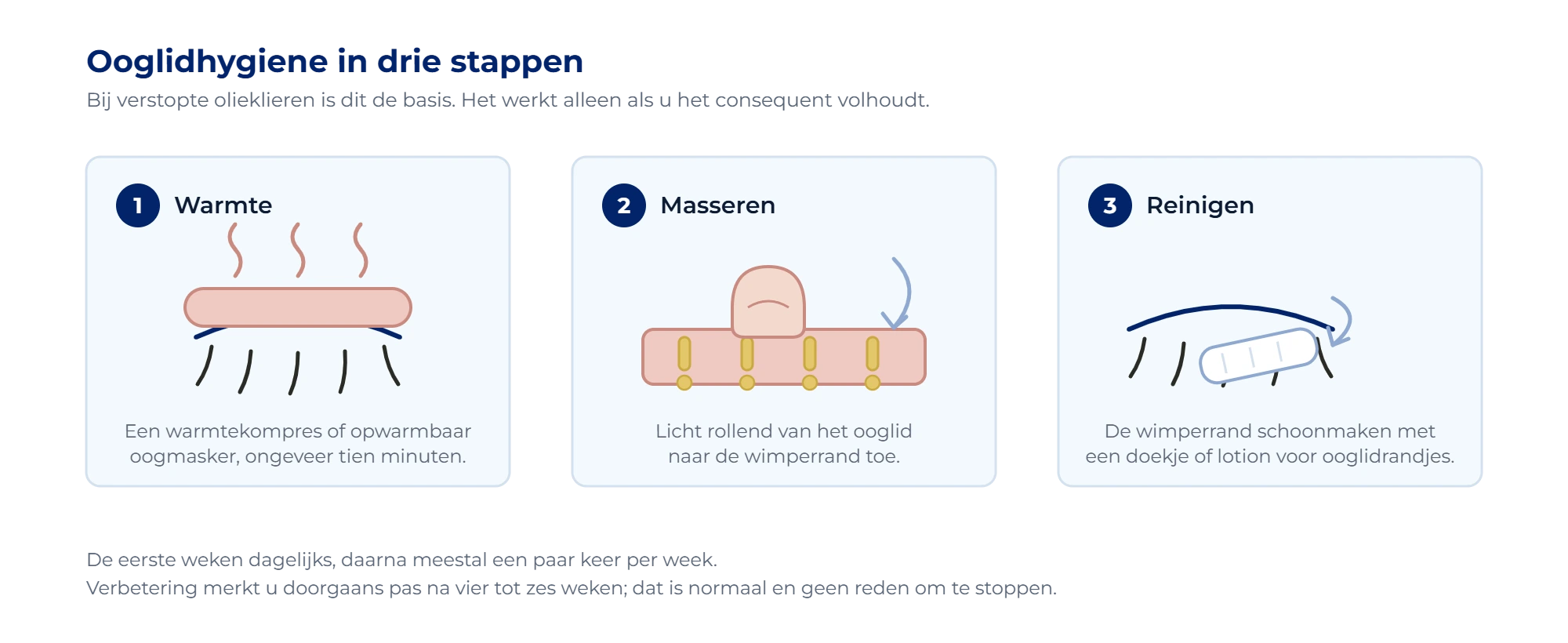
- Warmth. A warm compress or heatable eye mask for about ten minutes, so the thickened oil becomes liquid.
- Massage. With a finger, roll gently from the lid towards the lash line so the oil comes out.
- Cleaning. Clean the lash line with a special wipe or lotion.
Daily at first, then usually a few times a week. Improvement usually takes four to six weeks; that is normal and no reason to stop.
Meibomian gland expression in the practice
If the glands are too blocked to clear at home, we express them in the practice under the slit lamp. It takes a few minutes and feels like firm pressure on the lid.
Treating blepharitis
If blepharitis is present, we treat it first; while the lid margin is inflamed, other treatments have little chance.
When we refer
With corneal damage, suspected autoimmune disease or insufficient results, we consult your GP or refer to an ophthalmologist, for example for prescription anti-inflammatory drops.
Punctal plugs: keeping tear fluid on the eye
If drops and eyelid hygiene are not enough, a punctal plug is often the next step: instead of adding fluid, we keep your own tears on the eye.
What is a punctal plug?
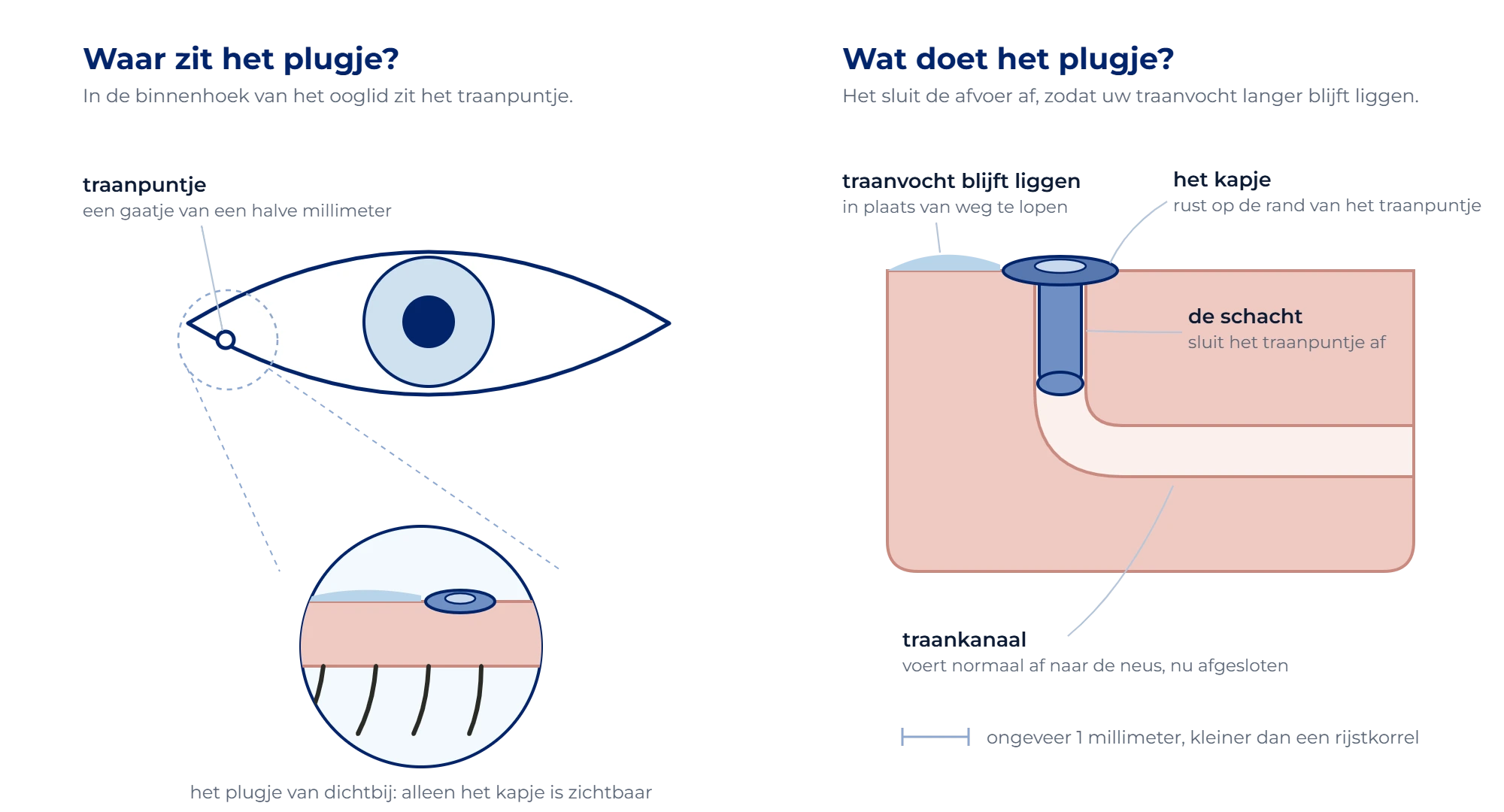
In the inner corner of your lids is a tiny opening, the tear punctum, through which tears drain to your nose. A punctal plug is a tiny plug, smaller than a grain of rice, that closes this opening so your own tears stay on the eye longer.
When do we place them?
For dry eyes with too little tear fluid, when drops, eyelid hygiene and adjustments do not help enough. We do not place them with an active eye infection, untreated blepharitis or eyes that already water a lot. We always treat an inflamed lid margin first.
Which plugs do we use?
- Dissolvable long-acting plugs. These sit in the tear duct, are invisible and dissolve after about three to six months. Good for testing whether plugs help you.
- Silicone plugs. These have a small cap resting on the punctum. They stay until removed, which is always possible with tweezers. Fully reversible.
We discuss which suits you during the examination. We often start with the dissolvable type.
How are they placed?
During a normal consultation in our practice, without cutting or stitches.
- We measure the size of your punctum so the plug fits exactly.
- You get an anaesthetic drop.
- With a thin instrument we insert the plug. It takes less than a minute per eye.
- We check under the slit lamp that the plug is in place.
We usually start with the lower lid and assess at the follow-up whether that is enough. Most people feel no pain, only brief pressure. Afterwards you can go home and drive yourself. Do not rub your eyes for the first fifteen minutes.
What will you notice?
Many people notice within days that their eyes burn less and they need fewer drops. We are honest about the evidence: studies show improvement, but a large international review found the evidence limited and the effect varies per person. That is why we check personally whether it works for you.
Possible disadvantages
- The plug can fall out by itself. This is the most common side effect; how often varies by plug type and person.
- Watery eyes. If too much fluid is retained, the eye may overflow. A silicone plug can then be removed or replaced with a smaller one.
- A slight feeling of something in the eye, usually temporary.
- Rare: irritation or inflammation of the punctum or tear duct.
Do you use prescription eye drops, e.g. for glaucoma? Tell us, as a plug also keeps that medication on the eye longer.
Follow-up
We see you again after placement to check the plug, your symptoms and whether the other eye or upper lid needs treatment.
Punctal plugs have their own fee, including the dry eye examination and follow-up. You can find the amount on our rates page.
What can you do yourself?
- Blink consciously and fully during screen work. Briefly squeezing your eyes helps spread the oil.
- Place your screen lower than eye level; your lids then cover more of the eye.
- Take breaks: every twenty minutes, look into the distance for twenty seconds.
- Direct air flow away from your face: in the car, under air conditioning and fans.
- Increase humidity in rooms with underfloor heating or air conditioning.
- Use a daily warm compress if symptoms are worst in the morning.
- Use drops preventively, at fixed times, and choose preservative-free with frequent use.
- Give your lenses a rest: wearing glasses a few days a week often helps.
- Review your medication with your GP if symptoms started after a new medicine.
- Stop smoking; passive smoking also worsens symptoms.
A common question: does drinking lots of water help? Drinking enough is healthy, but there is no evidence that extra water cures dry eyes.
How quickly will you notice improvement?
Artificial tears relieve immediately, but only while you use them. Eyelid hygiene needs patience: four to six weeks. A punctal plug often works within days.
Dry eyes are usually chronic. The goal is few symptoms with manageable maintenance, so we always plan an evaluation.
Frequently asked questions about dry eyes
Do I need a referral for a dry eye examination?
We like to work together with your GP and therefore ask you for a referral. That way your GP is informed from the start and we can coordinate your care properly. GPs can refer easily via ZorgDomein.
Is the examination covered by insurance?
The examination is fully covered and does not count towards your deductible. Punctal plugs have their own fee, which you can find on our rates page.
Why do my eyes water when they are dry?
Because a dry, irritated surface triggers reflex tears. They are watery, lack oil and do not stay. Watery eyes are a common sign of dryness.
Which eye drops are best?
It depends on the type. With fast evaporation, drops with lipids often work better; with too little fluid, a watery drop or gel. Using drops more than four times a day? Choose preservative-free.
Can I keep wearing contact lenses?
Usually yes. A different material, shorter replacement schedule or other solution is often enough. With severe symptoms we advise glasses temporarily.
Does placing a punctal plug hurt?
You get an anaesthetic drop. For most people it does not hurt; you may feel brief pressure. It takes less than a minute per eye.
Can a punctal plug be removed?
Yes. A silicone plug is easily removed with tweezers; a dissolvable plug dissolves by itself. The treatment is reversible.
Do dry eyes ever go away?
With a clear temporary cause, such as a medicine, a period of heavy screen use or recovery after laser surgery, often yes. Usually it is chronic but well manageable.
Can dry eyes cause damage?
Long-term untreated dryness can damage the cornea. That is exactly what we detect with the dye test and want to prevent.
Does omega-3 help?
Studies disagree. Some people benefit, especially with oil gland problems. We see it as an addition, not a replacement for eyelid hygiene.
How long does the appointment take?
Allow about thirty minutes for the dry eye examination.
Can I drive after the appointment?
We do not use dilating drops for the dry eye examination, so usually yes. If your pupil is dilated for another reason, your vision is blurred for a few hours and you may not drive. Bring sunglasses.
Dry eye examination in Nijmegen, Gorinchem or Zwolle
We work by appointment only, so there is enough time for a careful examination. Your GP can refer you via ZorgDomein.
085 225 23 69
Nijmegen
Consultation hours: usually FridayGroenestraat 294, 6531 JC Nijmegen
Business centre het BCG — please report to reception

Gorinchem
Consultation hours: usually Friday and SaturdayColvenierstraat 1b, 4205 JN Gorinchem
De Colvenier — please take a seat at the table in the central hall

Zwolle
Consultation hours: usually MondayStraussplein 5, 8031 AE Zwolle
Holtenbroek GP centre — GP waiting room
Read also: Eye health check · What is an optometrist? · Rates and insurance · For referrers · Frequently asked questions
This page was written by Ali Awad, optometrist at Novio Oogzorg, and reviewed on 15 September 2026. The information is general and does not replace a personal examination.
Suffering from dry eyes?
We work by appointment and without a waiting list, in Nijmegen, Gorinchem and Zwolle. Call +31 85 225 23 69 or use the contact form.